Hi Friend,
Get the download, PDF style:
Featured Lesson: A Quiet Reciprocity
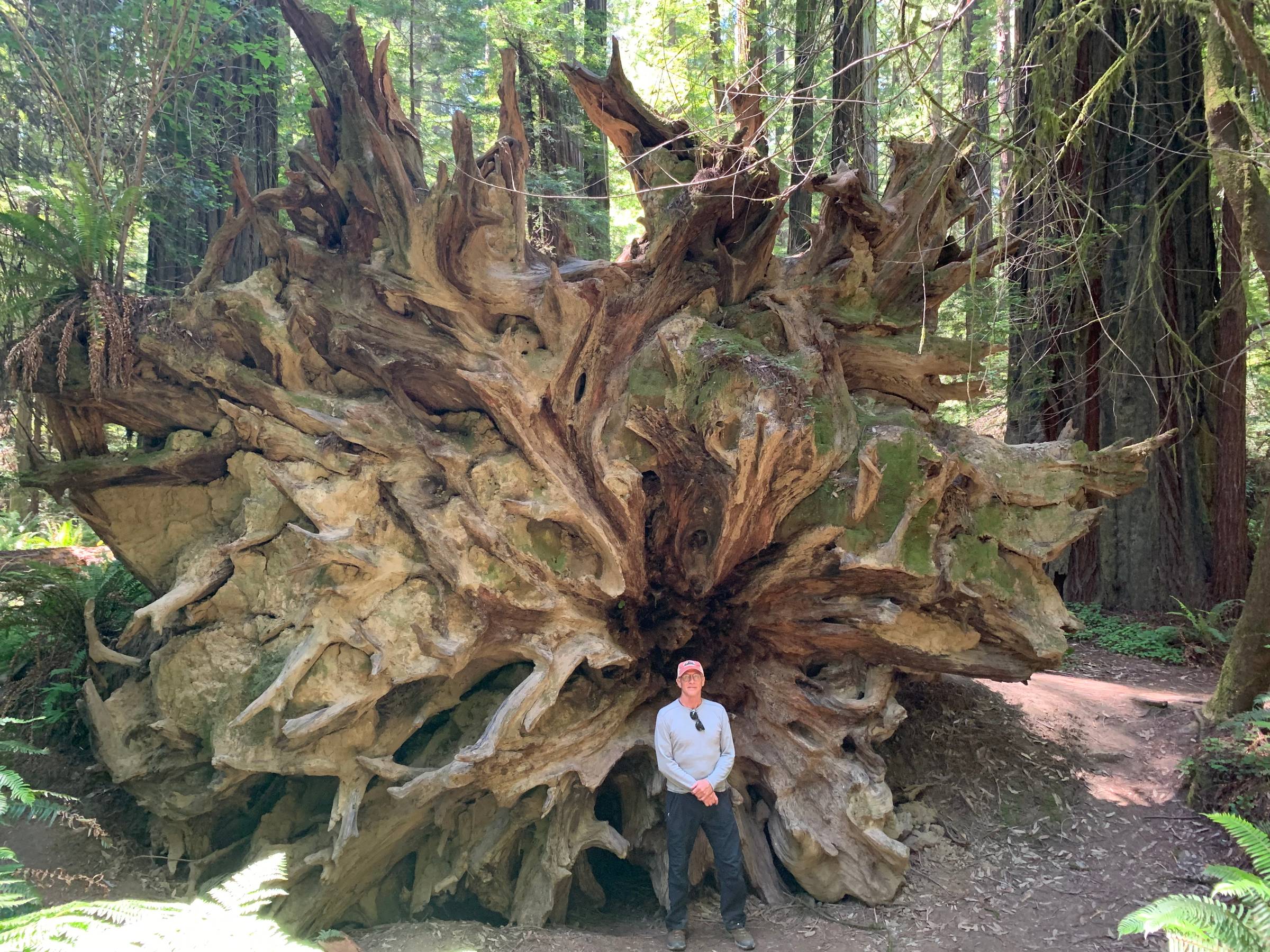
The above photo of me standing at the base of an uprooted redwood in Humboldt just a few weeks ago seems to do a great job of showing scale. But with a little imagination, it’s not too difficult to see as much more. What looks like a tangle of roots is closer to a lung turned inside out (especially if you’re a pranayama teacher:) — the same basic exchange is happening in that soil that’s happening in your chest right now.
Here’s how it works: you inhale oxygen and exhale carbon dioxide. A tree does the reverse. It pulls CO2 in through its leaves, splits it apart using sunlight and chlorophyll, keeps the carbon to build itself — trunk, bark, root — and releases the oxygen back out. A single mature tree absorbs somewhere north of 48 pounds of CO2 a year and releases oxygen in return. A redwood, given centuries instead of decades, does this at a different order of magnitude entirely — a coastal redwood can lock away roughly 250 tons of carbon over its lifespan, most of it held in that thick, fire-resistant bark. Stand at the base of one of those root systems, the way I did, and you’re looking at two and a half centuries of exhaled breath made solid.
Every fifth breath you take, on average, is built from oxygen a tree released. You are, quite plainly, made partly of what trees exhale, and they are quite plainly built partly of what you exhale. The “atmosphere” is just the name we give to the shared lung between species.
Richard Powers spent the length of The Overstory making the same case in narrative form — that trees aren’t scenery for the human plot, they’re characters running their own vast, patient timeline underneath ours, communicating and cooperating in ways we’re only beginning to understand. The Secret Language of Trees covers similar ground from the documentary side: the mycorrhizal networks fungi build between root systems, letting trees share carbon, water, and warning signals with neighbors — even neighbors of different species. A forest, seen this way, stops being a collection of individual trees and starts looking like a single loosely-federated organism, trading resources underground the same way your body trades oxygen for CO2 with the world above it.
What stopped me at that beautiful fallen giant was its size. But it was soon to become more about the timeline that it represents. That root system was likely doing this quiet trade of gases with the atmosphere before my grandparents were born, and it kept doing it, invisibly, every single day, without applause, without effort, without anyone noticing — until it fell over and finally became visible enough for a tourist with a camera to stand in front of it.
That’s most of what actually keeps us alive: exchanges too slow and too constant to register as events. Breath is one of the few of these you can actually feel happening, if you slow down enough to pay attention to it. Which might be the entire case for prāṇāyāma in one sentence — not controlling your breath, but noticing that you’re already in a centuries-long conversation with something much older and much larger than you, and it’s your turn to answer.
Much love, Dennis